1.基本概述
贪心算法是一种解决优化问题的算法范例,其基本思想是每一步都选择当前状态下的最优解,希望通过局部最优的选择最终得到全局最优解。
比如Dijkstra(选取当前距离最小的顶点)、Prim(选取当前距离最小的顶点)、Kruskal(选取当前距离最短的边)。
因为没有考虑所有可能,局部最优的堆叠不一定让最终解最优,比如Dijkstra算法处理负环的时候。
Bellman-Ford并没有考虑局部距离最小的顶点,而是每次都处理所有边,所以不是贪心算法,当然效率不如 Dijkstra。
2.活动选择问题
要在一个会议室举办 n 个活动
每个活动有它们各自的起始和结束时间
找出在时间上互不冲突的活动组合,能够最充分利用会议室(举办的活动次数最多)
优先选择最先结束的活动
package com.dreams;

import java.util.ArrayList;
import java.util.Arrays;
import java.util.Comparator;
import java.util.List;

/**
 * 活动选择问题 - 贪心解法
 * Leetcode 435 无重叠区间本质就是活动选择问题
 */
public class ActivitySelectionProblem {

    /*
        要在一个会议室举办 n 个活动
        - 每个活动有它们各自的起始和结束时间
        - 找出在时间上互不冲突的活动组合,能够最充分利用会议室(举办的活动次数最多)
        4. 优先选择最先结束的活动
     */

    static class Activity {
        int index;
        int start;
        int finish;

        public Activity(int index, int start, int finish) {
            this.index = index;
            this.start = start;
            this.finish = finish;
        }

        public int getFinish() {
            return finish;
        }

        @Override
        public String toString() {
            return "Activity(" + index + ")";
        }
    }

    public static void main(String[] args) {
        Activity[] activities = new Activity[]{
                new Activity(0, 1, 3),
                new Activity(1, 2, 4),
                new Activity(2, 3, 5)
        };
        Arrays.sort(activities, Comparator.comparingInt(Activity::getFinish));
        System.out.println(Arrays.toString(activities));
        System.out.println(select(activities));
    }

    public static int select(Activity[] activities) {
        Arrays.sort(activities, Comparator.comparingInt(Activity::getFinish));
        List<Activity> result = new ArrayList<>();
        Activity prev = activities[0]; // 上次被选中的活动
        result.add(prev);
        for (int i = 1; i < activities.length; i++) {
            Activity curr = activities[i]; // 正在处理的活动
            if (curr.start >= prev.finish) {
                result.add(curr);
                prev = curr;
            }
        }
        return activities.length - result.size();
    }

}
3.分数背包问题
1. n个物品都是液体,有重量和价值
2. 现在你要取走 10升 的液体
3. 每次可以不拿,全拿,或拿一部分,问最高价值是多少
编号 重量(升) 价值
0 4 24 水
1 8 160 牛奶 选中 7/8
2 2 4000 五粮液 选中
3 6 108 可乐
4 1 4000 茅台 选中
简化起见,给出的数据都是【价值/重量】能够整除,避免计算结果中出现小数,增加心算难度。
分数背包问题:
- 首先,对物品数组按照单位价值(价值/重量)从大到小排序。
- 然后,遍历排序后的物品数组,如果当前物品的重量小于等于背包剩余容量,则将该物品全部拿走,更新背包剩余容量和已获得的最大价值;否则,根据当前物品的单位价值拿走部分物品,更新最大价值,并退出循环。
package com.dreams;

import java.util.Arrays;
import java.util.Comparator;

/**
 * 分数背包问题 - 贪心解法
 */
public class FractionalKnapsackProblem {

    static class Item {
        int index;
        int weight;
        int value;

        public Item(int index, int weight, int value) {
            this.index = index;
            this.weight = weight;
            this.value = value;
        }

        public int unitValue() {
            return value / weight;
        }

        @Override
        public String toString() {
            return "Item(" + index + ")";
        }
    }

    public static void main(String[] args) {
        Item[] items = new Item[]{
                new Item(0, 4, 24),
                new Item(1, 8, 160),
                new Item(2, 2, 4000),
                new Item(3, 6, 108),
                new Item(4, 1, 4000),
        };
        select(items, 10);
    }

    static void select(Item[] items, int total) {
        Arrays.sort(items, Comparator.comparingInt(Item::unitValue).reversed());
        int max = 0; // 最大价值
        for (Item item : items) {
            System.out.println(item);
            if (total >= item.weight) { // 可以拿完
                total -= item.weight;
                max += item.value;
            } else { // 拿不完
                max += total * item.unitValue();
                break;
            }
        }
        System.out.println("最大价值是:" + max);
    }


}
4.零钱兑换II
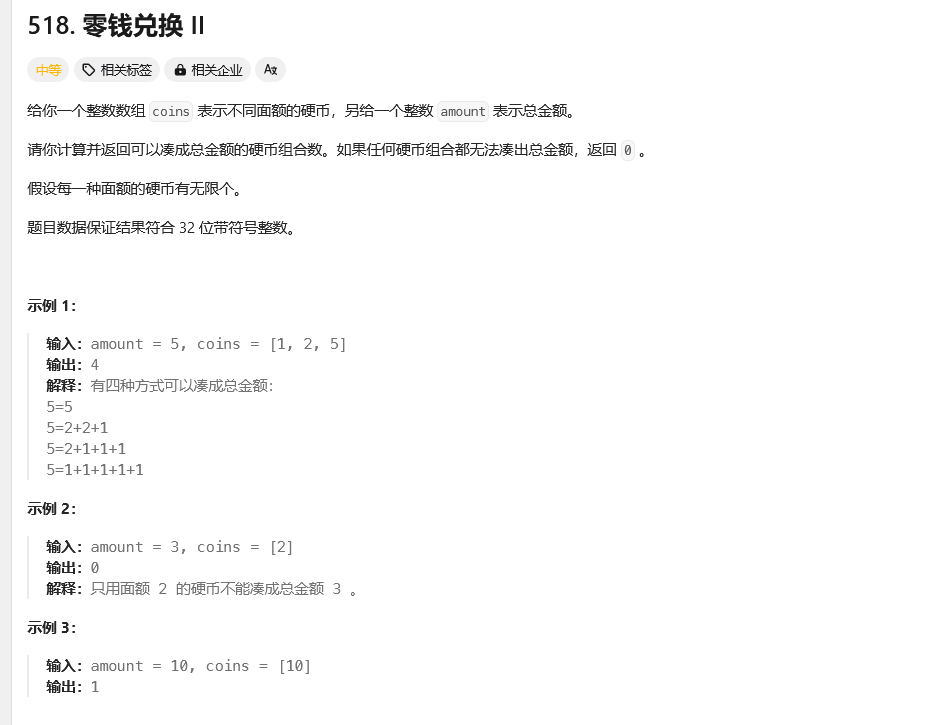
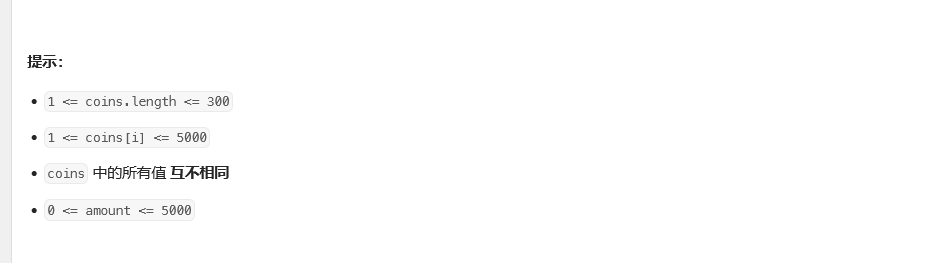
通过递归方法解决零钱兑换问题的算法。这种方法通过穷举所有可能的组合来计算凑成总金额的方式数:
package com.dreams.dynamicprogramming;

/**
 * 零钱兑换 II - 穷举解法
 * 凑成总金额有几种凑法?
 */
public class Leetcode518 {
    public int change(int[] coins, int amount) {
        return rec(0, coins, amount);
    }

    /**
     * 求凑成剩余金额的解的个数
     *
     * @param index     当前硬币索引
     * @param coins     硬币面值数组
     * @param remainder 剩余金额
     * @return 解的个数
     */
    public int rec(int index, int[] coins, int remainder) {
        // 情况1:剩余金额 < 0 - 无解
        int count = 0;
        if (remainder < 0) {
            return 0;
        }
        // 情况2:剩余金额 == 0 - 有解
        else if (remainder == 0) {
            return 1;
        }
        // 情况3:剩余金额 > 0 - 继续递归
        else {
            for (int i = index; i < coins.length; i++) {
                count += rec(i, coins, remainder - coins[i]);
            }
        }
        return count;
    }

    public static void main(String[] args) {
        Leetcode518 leetcode = new Leetcode518();
        int count = leetcode.change(new int[]{1, 2, 5}, 5);
        System.out.println(count);
    }

}
递归过程:
由小到大递归过程
rec(1,5)
    rec(1,4)
    | rec(1,3)
    | | rec(1,2)
    | | | rec(1,1)
    | | | | rec(1,0)
    | | | | rec(2,-1)
    | | | | rec(5,-4)
    | | | rec(2,0)
    | | | rec(5,-3)
    | | rec(2,1)
    | | | rec(2,-1)
    | | | rec(5,-4)
    | | rec(5,-2)
    | rec(2,2)
    | | rec(2,0)
    | | rec(5,-3)
    | rec(5,-1)
    rec(2,3)
    | rec(2,1)
    | | rec(2,-1)
    | | rec(5,-4)
    | rec(5,-2)
    rec(5,0)

由大到小递归过程
rec(5,5)
    rec(5,0)
    rec(2,3)
    | rec(2,1)
    | | rec(2,-1)
    | | rec(1,0)
    | rec(1,2)
    | | rec(1,1)
    | | | rec(1,0)
    rec(1,4)
    | rec(1,3)
    | | rec(1,2)
    | | | rec(1,1)
    | | | | rec(1,0)
顺序优化(从大到小传递,可以减少递归次数):
int count = leetcode.change(new int[]{5, 2, 1}, 5);使用贪心算法可能出现错误答案,这里使用动态规划。
package com.dreams;

public class Leetcode518 {
    public int change(int amount, int[] coins) {
        int[] dp = new int[amount + 1];
        dp[0] = 1;

        for (int coin : coins) {
            for (int i = coin; i <= amount; i++) {
                dp[i] += dp[i - coin];
            }
        }

        return dp[amount];
    }

    public static void main(String[] args) {
        Leetcode518 leetcode = new Leetcode518();
        int count = leetcode.change(5, new int[]{1, 2, 5});
        System.out.println(count);
    }
}
5.0-1背包问题
同样可能无法达到最优解,而需要使用动态规划。
参考