1.两数之和II
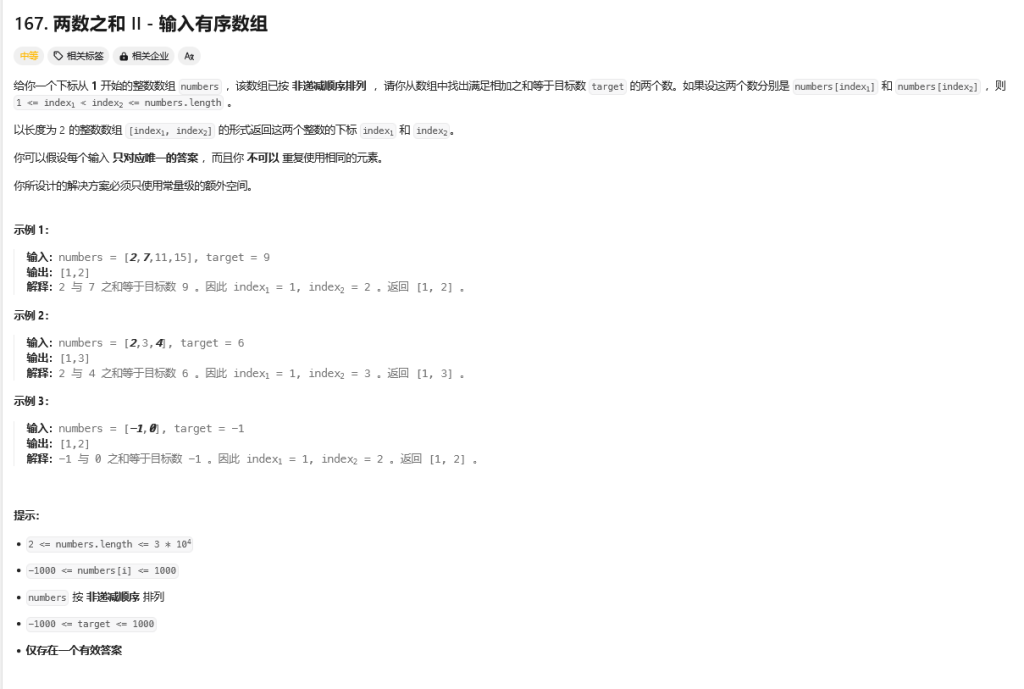
只是简单使用使用双指针即可,设置两个指针 i 和 j 分别指向最左侧和最右侧的数字,它俩指向的数字和与 target 相比,如果小于 target就i++向右找,大于target就j– 向左找,只要等于 target 就找到了。
package com.dreams.leetcode;

import java.util.Arrays;

/**
 * 2数之和
 */
public class Leetcode167 {
    public static void main(String[] args) {
        System.out.println(Arrays.toString(twoSum(new int[]{2, 7, 11, 15}, 9)));
    }
    static public int[] twoSum(int[] numbers, int target) {
        int i = 0;
        int j = numbers.length - 1;
        while (i < j) {
            int sum = numbers[i] + numbers[j];
            if (sum < target) {
                i++;
            } else if (sum > target) {
                j--;
            } else {
                break;
            }
        }
        return new int[]{i + 1, j + 1};
    }
}
2.三数之和
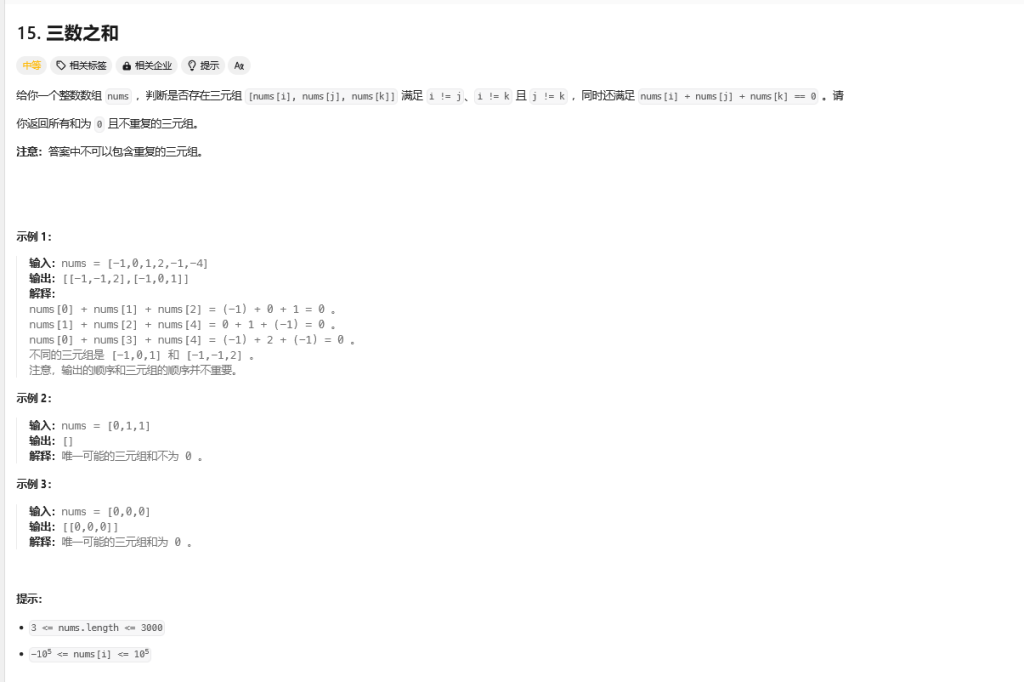
这里就是先固定一个数,再递归使用两数之和的方法。
代码:
package com.dreams.leetcode;

import java.util.ArrayList;
import java.util.Arrays;
import java.util.LinkedList;
import java.util.List;

/**
 *  3数之和
 */
public class Leetcode15 {

    static List<List<Integer>> threeSum(int[] nums) {
        Arrays.sort(nums);
        List<List<Integer>> result = new LinkedList<>();
        dfs(3, 0, nums.length - 1, 0, nums,
                new LinkedList<>(), result);
        return result;
    }

    static void dfs(int n, int i, int j, int target, int[] nums,
                    LinkedList<Integer> stack,
                    List<List<Integer>> result) {
        if (n == 2) {
            // 套用两数之和求解
            twoSum(i, j, nums, target, stack, result);
            return;
        }
        for (int k = i; k < j; k++) {
            // 检查重复
            if (k > i && nums[k] == nums[k - 1]) {
                continue;
            }
            // 固定一个数字,再尝试 n-1 数字之和
            stack.push(nums[k]);
            dfs(n - 1, k + 1, j, target - nums[k], nums, stack, result);
            stack.pop();
        }
    }

    public void twoSum(int i, int j, int[] numbers, int target,
                              LinkedList<Integer> stack,
                              List<List<Integer>> result) {
        while (i < j) {
            int sum = numbers[i] + numbers[j];
            if (sum < target) {
                i++;
            } else if (sum > target) {
                j--;
            } else { // 找到解
                ArrayList<Integer> list = new ArrayList<>(stack);
                list.add(numbers[i]);
                list.add(numbers[j]);
                result.add(list);
                // 继续查找其它的解
                i++;
                j--;
                while (i < j && numbers[i] == numbers[i - 1]) {
                    i++;
                }
                while (i < j && numbers[j] == numbers[j + 1]) {
                    j--;
                }
            }
        }
    }

    public static void main(String[] args) {
        long start = System.currentTimeMillis();
        int[] candidates = {-4, -1, -1, 0, 0, 1, 1, 2};
        System.out.println(threeSum(candidates));
    }
}
3.四数之和
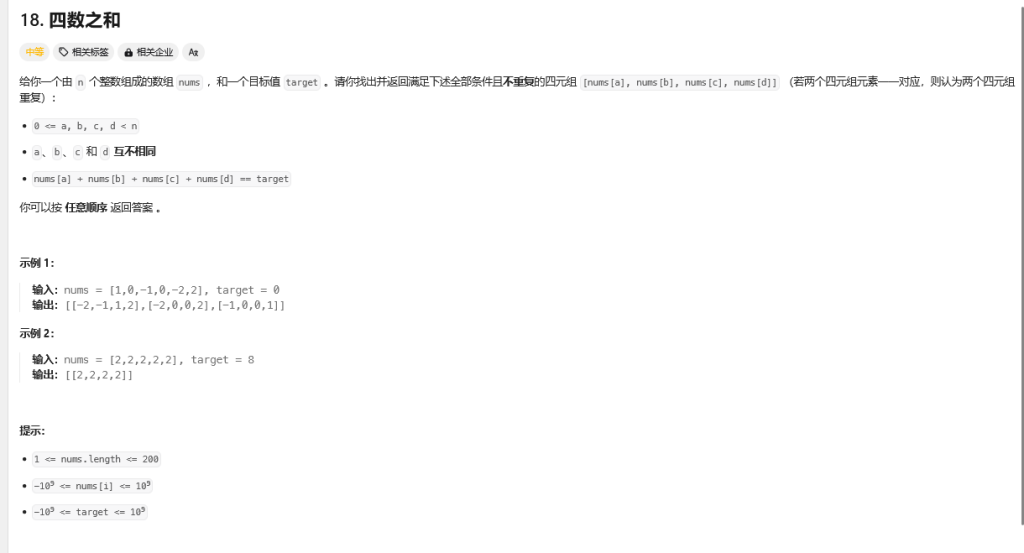
代码:
package com.dreams.leetcode;

import java.util.ArrayList;
import java.util.Arrays;
import java.util.LinkedList;
import java.util.List;

/**
 * 4数之和
 */
public class Leetcode18 {

    static List<List<Integer>> fourSum(int[] nums, int target) {
        Arrays.sort(nums);
        List<List<Integer>> result = new LinkedList<>();
        dfs(4, 0, nums.length - 1, target, nums,
                new LinkedList<>(), result);
        return result;
    }

    static void dfs(int n, int i, int j, int target, int[] nums,
                    LinkedList<Integer> stack,
                    List<List<Integer>> result) {
        if (n == 2) {
            // 套用两数之和求解
            twoSum(i, j, nums, target, stack, result);
            return;
        }
        for (int k = i; k < j - (n - 2); k++) { // 四数之和 i <j-2  三数之和 i <j-1
            // 检查重复
            if (k > i && nums[k] == nums[k - 1]) {
                continue;
            }
            // 固定一个数字,再尝试 n-1 数字之和
            stack.push(nums[k]);
            dfs(n - 1, k + 1, j, target - nums[k], nums, stack, result);
            stack.pop();
        }
    }

    static public void twoSum(int i, int j, int[] numbers, int target,
                              LinkedList<Integer> stack,
                              List<List<Integer>> result) {
        while (i < j) {
            int sum = numbers[i] + numbers[j];
            if (sum < target) {
                i++;
            } else if (sum > target) {
                j--;
            } else { // 找到解
                ArrayList<Integer> list = new ArrayList<>(stack);
                list.add(numbers[i]);
                list.add(numbers[j]);
                result.add(list);
                // 继续查找其它的解
                i++;
                j--;
                while (i < j && numbers[i] == numbers[i - 1]) {
                    i++;
                }
                while (i < j && numbers[j] == numbers[j + 1]) {
                    j--;
                }
            }
        }
    }

    public static void main(String[] args) {
        System.out.println(fourSum(new int[]{1, 0, -1, 0, -2, 2}, 0));
    }
}
利扣解:
package com.dreams.leetcode;

import java.util.ArrayList;
import java.util.Arrays;
import java.util.List;

class Solution {
    public List<List<Integer>> fourSum(int[] nums, int target) {
        List<List<Integer>> quadruplets = new ArrayList<List<Integer>>();
        if (nums == null || nums.length < 4) {
            return quadruplets;
        }
        Arrays.sort(nums);
        int length = nums.length;
        for (int i = 0; i < length - 3; i++) {
            if (i > 0 && nums[i] == nums[i - 1]) {
                continue;
            }
            if ((long) nums[i] + nums[i + 1] + nums[i + 2] + nums[i + 3] > target) {
                break;
            }
            if ((long) nums[i] + nums[length - 3] + nums[length - 2] + nums[length - 1] < target) {
                continue;
            }
            for (int j = i + 1; j < length - 2; j++) {
                if (j > i + 1 && nums[j] == nums[j - 1]) {
                    continue;
                }
                if ((long) nums[i] + nums[j] + nums[j + 1] + nums[j + 2] > target) {
                    break;
                }
                if ((long) nums[i] + nums[j] + nums[length - 2] + nums[length - 1] < target) {
                    continue;
                }
                int left = j + 1, right = length - 1;
                while (left < right) {
                    long sum = (long) nums[i] + nums[j] + nums[left] + nums[right];
                    if (sum == target) {
                        quadruplets.add(Arrays.asList(nums[i], nums[j], nums[left], nums[right]));
                        while (left < right && nums[left] == nums[left + 1]) {
                            left++;
                        }
                        left++;
                        while (left < right && nums[right] == nums[right - 1]) {
                            right--;
                        }
                        right--;
                    } else if (sum < target) {
                        left++;
                    } else {
                        right--;
                    }
                }
            }
        }
        return quadruplets;
    }
}
4.盛最多水的容器
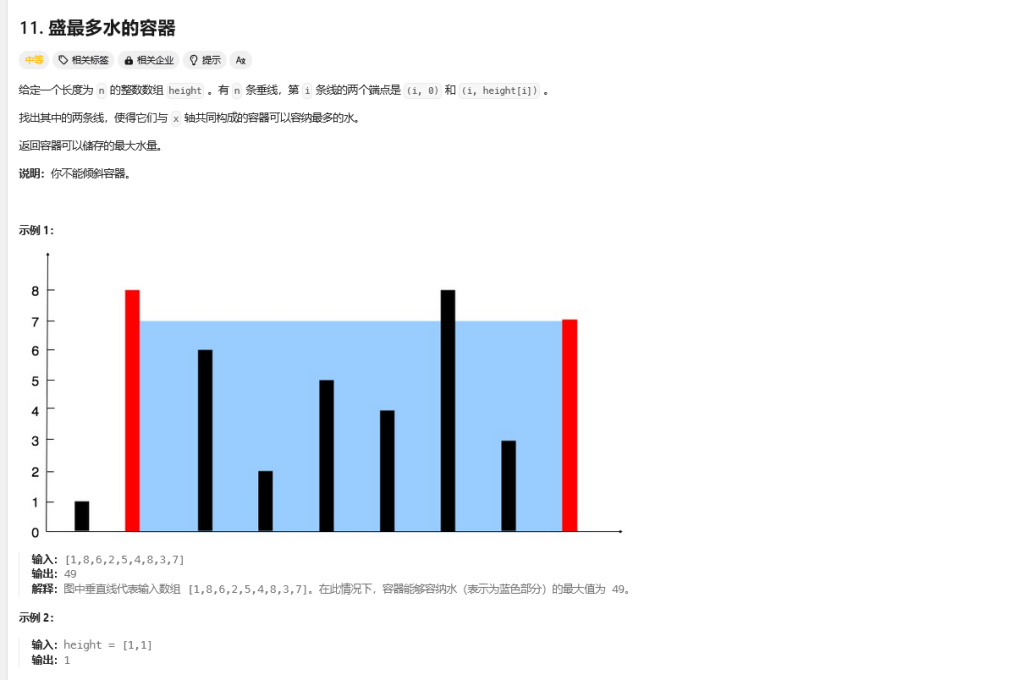

同样使用双指针
package com.dreams.leetcode;

/**
 * 盛最多水的容器
 */
public class Leetcode11 {
    static int maxArea(int[] height) {
        int i = 0;
        int j = height.length - 1;
        int max = 0;
        while (i < j) {
            if (height[i] < height[j]) {
                int area = (j - i) * height[i];
                max = Math.max(max, area);
                i++;
            } else {
                int area = (j - i) * height[j];
                max = Math.max(max, area);
                j--;
            }
        }
        return max;
    }

    public static void main(String[] args) {
        System.out.println(maxArea(new int[]{1, 8, 6, 2, 5, 4, 8, 3, 7})); // 49
    }
}
参考